Safe lifting begins long before a worker presses a pendant button or starts a forklift. It begins with practical, repeatable instruction. This guide explores how to train workers for safe lifting equipment use through seven focused methods, including equipment familiarization, hazard recognition, supervised practice, inspection routines, load assessment, communication, and refresher coaching.
The need is measurable. OSHA estimates that powered industrial trucks cause about 85 workplace fatalities and 35,000 serious injuries in the United States each year. Its Powered Industrial Trucks Safety topic also stresses operator training, evaluation, and authorization. HSE’s Lifting Operations and Lifting Equipment Regulations guidance adds another essential point: equipment condition, examination, and safe planning must work together. Training alone cannot repair a damaged sling or an overloaded hook.
Dr. David Michaels, former Assistant Secretary of Labor for OSHA, said, “Safety and health programs are most effective when they are integrated into a company’s overall business operation.” That principle fits lifting work closely. A worker should know where the rated-capacity plate sits, how a twisted sling feels, and when a swinging load demands a stop. Short practice sessions help. Realistic scenarios help more. A classroom certificate is not proof of competence.
There is an uncomfortable truth. Even experienced operators can rush when production targets tighten. Therefore, effective training must include observation, questioning, correction, and honest re-evaluation. Supervisors need to notice small warning signs, such as unclear hand signals or a load lifted without a pre-use check. Good systems are never perfect. They improve after near misses, equipment changes, and worker feedback.
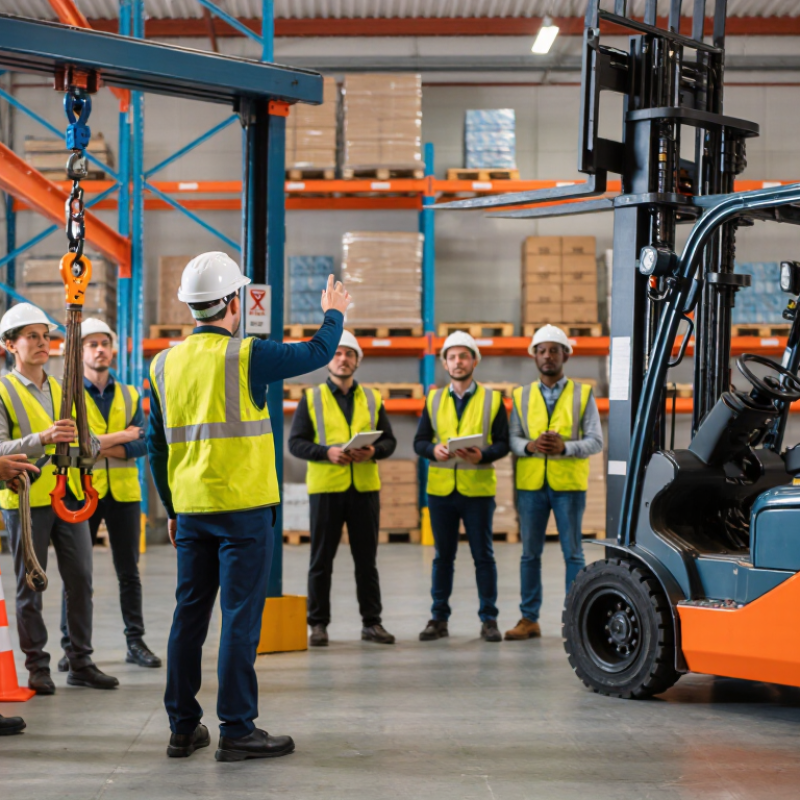
Safe lifting begins with defining the risk, not buying equipment. OSHA safety records cite about 85 forklift deaths each year, while NIOSH estimates roughly 34,900 serious injuries annually. Common causes include unstable loads, blind corners, poor visibility, and untrained operators. A crowded aisle can turn a small mistake into a fatal event.
Walk the site before selecting gear. Measure aisle widths, floor strength, rack height, load weight, and turning space. Choose lifting equipment with a capacity above the heaviest realistic load. Check forks, chains, wheels, controls, and warning devices before every shift. OSHA’s powered industrial truck guidance requires formal instruction, practical training, and workplace evaluation before independent operation. Refresher training is needed after unsafe behavior, equipment changes, or workplace hazards.
Use real loads during practice. Let workers approach a pallet, sound the horn, lift slowly, and stop when visibility disappears. A spotter should guide tight movements, but never stand beneath a suspended load. Training records should show the date, equipment type, instructor, and observed skills. Check understanding, not just attendance. A signed form proves little. We often focus on speed, and that is the weakness. The safest gear can still fail when its limits remain unclear.
| Training Method | Primary Risk Addressed | Required Knowledge and Practice | Recommended Safety Gear and Controls | Competency Verification | Regulatory or Evidence Basis |
|---|---|---|---|---|---|
| 1. Perform a documented hazard assessment before training | Struck-by incidents, tip-overs, falling loads, blind corners, unstable surfaces, and load-related injuries. |
|
Load-capacity information, warning signs, floor markings, barriers, adequate lighting, and a site-specific traffic plan. | Worker completes a route and load-risk checklist and correctly identifies at least three hazards during a practical walkthrough. | Powered industrial truck training must address workplace-related conditions and hazards; see 29 CFR 1910.178(l). |
| 2. Use structured classroom or online instruction | Incorrect operating decisions caused by inadequate knowledge of controls, capacity limits, and operating rules. |
|
Equipment-specific manuals, capacity plates, training diagrams, safety signs, and written operating procedures. | Written or electronic assessment covering equipment controls, load capacity, stability, pedestrian rules, and emergency actions. | OSHA requires formal instruction, practical training, and workplace evaluation for powered industrial truck operators under 29 CFR 1910.178(l)(2). |
| 3. Provide supervised hands-on equipment practice | Collisions, sudden movement, dropped loads, improper fork placement, and loss of control during lifting or travel. |
|
Seat belt or restraint system where provided, safety footwear, high-visibility clothing where required by the site, and a segregated practice area. | A qualified evaluator observes the operator completing each task without unsafe shortcuts and records the result. | OSHA requires practical training and demonstrations performed by the trainee; see 29 CFR 1910.178(l)(2)(ii). |
| 4. Teach load stability and capacity control | Tip-over, rearward or forward instability, falling materials, and overload-related equipment failure. |
|
Capacity plate, load backrest where required, approved pallets or containers, stable stacking surfaces, and load-securing devices when appropriate. | Operator correctly calculates or verifies capacity for sample loads and demonstrates safe lifting, lowering, and travel positions. | OSHA requires trucks to be operated within rated capacity and loads to be stable and safely arranged; see 29 CFR 1910.178(o). |
| 5. Separate pedestrians from moving equipment | Pedestrian struck-by and crushing incidents at intersections, loading areas, aisles, and reversing points. |
|
Guardrails, marked walkways, pedestrian gates, mirrors at blind corners, audible or visual warning devices, and high-visibility garments where justified by the risk assessment. | Worker completes a controlled route exercise, identifies blind spots, and demonstrates safe interaction with pedestrians. | OSHA requires operators to look in the direction of travel, slow down at congested areas and blind spots, and sound a warning when necessary; see 29 CFR 1910.178(n). |
| 6. Make pre-use inspections and defect reporting routine | Mechanical failures, brake or steering defects, damaged forks, tire failures, hydraulic leaks, and unsafe attachments. |
|
Inspection checklist, lockout or “out of service” tag, spill-control materials, and manufacturer-approved replacement parts or repairs. | Operator completes a documented inspection and correctly applies the defect-reporting and equipment-removal procedure. | OSHA requires industrial trucks to be examined before being placed in service and at least daily, or after each shift when used around the clock; see 29 CFR 1910.178(q)(7). |
| 7. Retrain after incidents, unsafe operation, or workplace changes | Recurring unsafe behavior, skill degradation, and failure to adapt to new equipment, attachments, routes, loads, or site conditions. |
|
Updated procedures, revised route maps, corrective-action records, and equipment-specific training materials. | Document the trigger for retraining, topics covered, practical evaluation, evaluator name, and authorization status. | OSHA requires refresher training after unsafe operation, an accident or near miss, evaluation failure, assignment to a different truck, or workplace changes; periodic evaluation is required at least once every three years under 29 CFR 1910.178(l)(4). |
|
Key safety data: The U.S. Occupational Safety and Health Administration reports that powered industrial trucks, including forklifts, are associated with approximately 85 fatal accidents and 34,900 serious injuries each year. Training must be delivered by a qualified person and tailored to the specific truck type, workplace conditions, and assigned tasks.
Sources: U.S. Occupational Safety and Health Administration, 29 CFR 1910.178 “Powered Industrial Trucks”; OSHA, “Powered Industrial Trucks — Forklifts”; National Institute for Occupational Safety and Health, workplace materials-handling safety guidance.
|
|||||
Unstable loads, blind corners, poor visibility, and untrained operators create major risks. A crowded aisle can turn one mistake into a severe accident.
Measure aisle width, floor strength, rack height, load weight, and turning space. Leave room for safe turning. Choose equipment rated above the heaviest realistic load.
Check the forks, chains, wheels, controls, and warning devices. Look for uneven forks or damaged parts. Do not ignore small defects.
Operators need formal instruction, practical training, and workplace evaluation. Practice with real loads. Attendance alone is not enough.
They should approach pallets slowly, sound the horn, and lift carefully. Stop when the load blocks visibility. A spotter may guide tight movements, but never stand beneath a suspended load.
Evaluate each operator at least once every three years. Use the actual equipment, workplace, and assigned tasks. A classroom quiz cannot show every practical weakness.
Repeat training after unsafe behavior, an accident, a near miss, or workplace changes. Training is also needed after switching equipment. Three years can pass quickly.
Records should show the date, equipment type, evaluator, observed skills, and corrective coaching. Compare paperwork with real behavior. A signed form proves little.
Learning how to train workers for safe lifting equipment use begins with identifying workplace hazards and selecting equipment suited to each task. Employers should explain common risks, including falling loads, tip-overs, struck-by incidents, and equipment failure. Training should follow applicable safety requirements and cover seven core skills: operating controls, maintaining stability, planning routes, recognizing load limits, communicating with spotters, parking safely, and responding to emergencies. Since forklift incidents contribute to about 85 worker deaths each year, practical risk awareness is essential.
Workers should also learn to read load charts and inspect hooks, slings, chains, forks, and safety devices before use, paying close attention to safe working load ratings. Classroom instruction must be reinforced with supervised, hands-on practice. Each operator should demonstrate safe performance before working independently. Refresher instruction, regular drills, and workplace audits help maintain good habits, while formal forklift evaluations should be completed at least every three years or sooner when performance concerns, unsafe behavior, or workplace changes arise.

 Liftara Lift